Ising Supercriticality and Universal Magnetocalorics in Spiral Antiferromagnet Nd3BWO9
Abstract
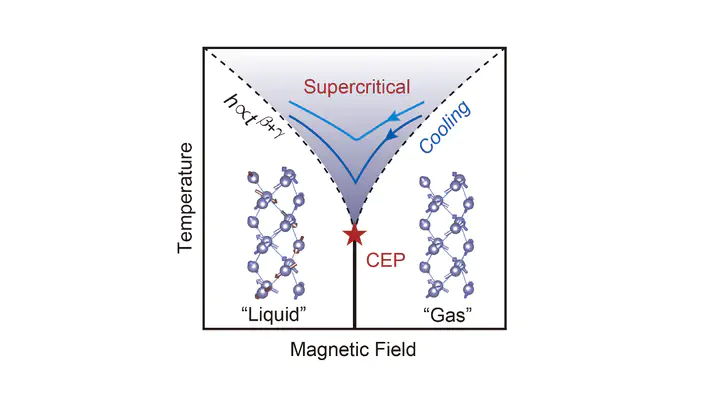
The celebrated analogy between the pressure-temperature phase diagram of a liquid-gas system and the field-temperature phase diagram of a ferromagnet has long been a cornerstone for understanding universality of phase transitions and critical phenomena. Here we extend this analogy to a highly frustrated antiferromagnet, the spiral Ising compound Nd3BWO9 with kagome layers. In its phase diagram, we identify a metamagnetic transition line with a critical endpoint (CEP) located at 𝜇0𝐻c ≃1.04 T and 𝑇c ≃0.3 K. Above the CEP, an Ising supercritical regime emerges with crossover lines that follow a universal scaling law, as evidenced by the specific heat, magnetic susceptibility, and magnetocaloric measurements. Remarkably, we observe critically enhanced magnetic cooling near the emergent CEP, characterized by a divergent magnetic Grüneisen ratio Γ𝐻 ∝1/𝑡𝛽+𝛾−1, with 𝛽 +𝛾 ≃1.563 the sum of critical exponents of the 3D Ising universality class and 𝑡 ≡(𝑇 −𝑇c)/𝑇c the reduced temperature. Adiabatic demagnetization from 2 K and 4 T reaches a minimum temperature of 195 mK, via a self-cascading process that combines supercritical and topological cooling. Our findings open a new avenue for studying supercritical phenomena and magnetic refrigeration with the frustrated rare-earth compounds RE3BWO9 and, more broadly, in Ising-anisotropic antiferromagnets such as spin ices.