Abstract
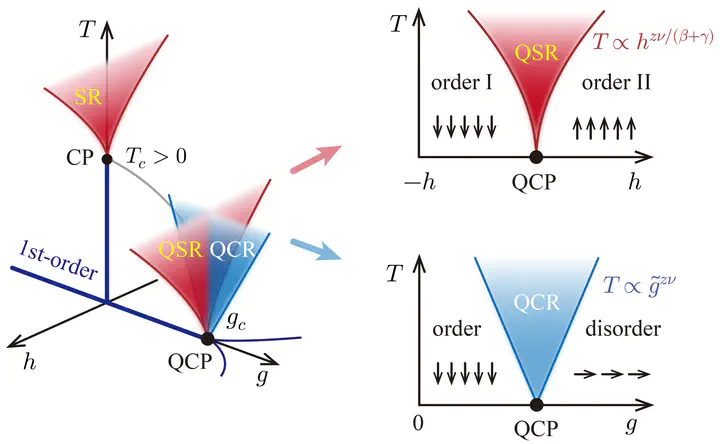
Quantum critical points ubiquitously emerge in strongly correlated systems, with their influence persisting at finite temperatures and external fields. A paradigmatic example is the quantum Ising magnet, where transverse field g controlling quantum fluctuations can expand the quantum critical point into an extended quantum critical regime. In this work, we propose a distinct quantum supercritical regime originating also from the quantum critical point but controlled by the longitudinal field h coupled to the order parameter. Through thermal tensor network simulations, we find the quantum supercritical regime is enclosed by the finite-temperature crossover boundaries T ∝ h^(zν/Δ), where z, ν and Δ≡β+γ are critical exponents. We comprehend the supercritical scaling via thermal data collapse based on the derived scaling form. Amongst other intriguing phenomena in quantum supercritical regime, there exists an enhanced magnetocaloric effect characterized by a universally diverging magnetic Grüneisen ratio Γ_h ∝ T^(−Δ/zν), which indicates that a small symmetry-breaking field h can generate dramatic temperature variation. We propose to observe the quantum supercritical regime in the Ising-chain compound CoNb2O6 and related quantum materials, revealing a helium-3-free pathway to millikelvin cooling via the supercritical magnetocaloric effect.