Abstract
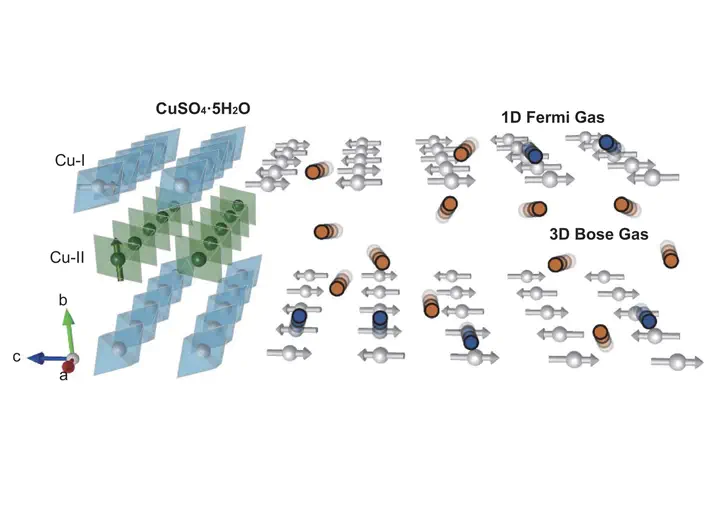
Near a quantum critical point (QCP), the low-temperature thermodynamics follows universal scaling laws. Using copper sulfate pentahydrate—a canonical spin-1/2 antiferromagnetic Heisenberg chain compound—we report the observation of a universal magnetocaloric effect (MCE) near a field-driven QCP. Remarkably, in the 1D quantum-critical regime, we obtain the universal magnetocaloric scaling function via adiabatic demagnetization measurements, which agrees with the analytical solution Ψ_Γ^F(x) of the critical 1D Fermi gas. This establishes the copper sulfate crystal as an ideal platform for studying quantum criticality and universal phenomena. Upon further cooling, our MCE and nuclear magnetic resonance measurements reveal a dimensional crossover to a 3D quantum-critical regime of the Bose–Einstein condensation (BEC) universality class, characterized by the scaling law Tc ∝ (Bc − B)^(2/3) and a clear data collapse of the magnetic Grüneisen ratio with the 3D Bose-gas scaling function Φ_Γ^B(x). Practically, this quantum-critical MCE enables cooling to 68.7 mK near the QCP and achieves a lowest temperature of 12.8 mK at zero field without the need for helium-3. Our work identifies a universal MCE in a common compound, establishing this magnon BEC system as a prototype quantum-critical coolant and a platform for next-generation millikelvin refrigeration.